Saturday, February 26, 2011

Ich bin der Welt abhanden gekommen

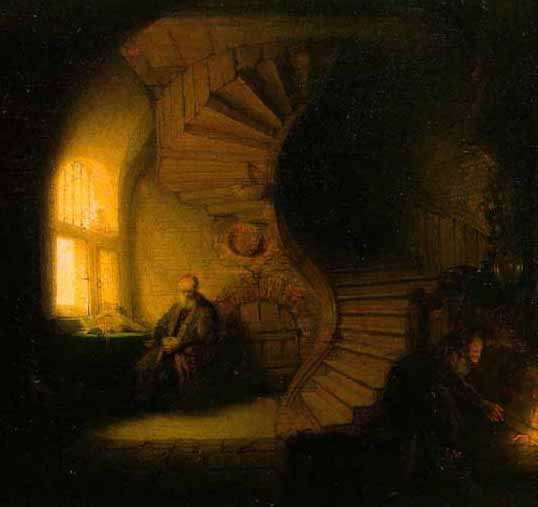
http://www.rjgeib.com/thoughts/solitude/solitude.jpg


Ich bin der Welt abhanden gekommen

Ich bin der Welt abhanden gekommen,
Mit der ich sonst viele Zeit verdorben,
Sie hat so lange nichts von mir vernommen,
Sie mag wohl glauben, ich sei gestorben!

Es ist mir auch gar nichts daran gelegen,
Ob sie mich für gestorben hält,
Ich kann auch gar nichts sagen dagegen,
Denn wirklich bin ich gestorben der Welt.

Ich bin gestorben dem Weltgetümmel,
Und ruh' in einem stillen Gebiet!
Ich leb' allein in meinem Himmel,
In meinem Lieben, in meinem Lied!

I am lost to the world


I am lost to the world
with which I used to waste so much time,
It has heard nothing from me for so long
that it may very well believe that I am dead!

It is of no consequence to me
Whether it thinks me dead;
I cannot deny it,
for I really am dead to the world.

I am dead to the world's tumult,
And I rest in a quiet realm!
I live alone in my heaven,
In my love and in my song!


Thanks to Joe Koczera, SJ for the reference to this poem.
 http://jesuitjoe.blogspot.com/

Friedrich Rückert (1788-1866)

With a musical setting by

Gustav Mahler (1860-1911)

Emily Ezust translates
Share/Save/Bookmark

Wednesday, January 26, 2011


Father Gabriel (Bunge) “Orthodoxy is the Fruit of My Whole Life as a Christian and a Monk”
By Archpriest Pavel Velikanov
Jan 25, 2011, 10:00

http://www.pravmir.com/article_1220.html

A famous Swiss Catholic theologian, Hieromonk Gabriel Bunge, converted to Orthodoxy on August 27th 2010 in Moscow, on the Eve of the Dormition of the Virgin Mary. It was Metropolitan Hilarion of Volokolamsk who received Fr. Gabriel into the Orthodox Church. We are glad to offer our readers translations of two interviews with Fr. Gabriel. The first interview “I came to the faith owing to my peers” was conducted by Archpriest Pavel Velikanov, the editor-in-chief of the scientific theological website “Bogoslos.ru” in 2008. At the time Fr. Gabriel was still a Catholic hieromonk. The second interview “One Can't Learn to Pray Sitting in a Warm Armchair” Fr. Gabriel had right after he had converted to Orthodoxy. It was conducted by a Russian Orthodox Christian Journal for Doubting Thomases – Foma.
Share/Save/Bookmark

Wednesday, January 12, 2011

For Some of Us This Is Not News

Where's the Media? L.A. Attorney Declares Many Abuse Accusations Against
Catholic Priests Are 'Entirely False'

By Dave Pierre | January 02, 2011 |

In a stunning ten-page declaration recently submitted to the Los Angeles County Superior Court, veteran attorney Donald H. Steier stated that his investigations into claims of sexual abuse by Catholic priests have uncovered vast fraud and that his probes have revealed that many accusations are completely false.


Read more:
http://www.newsbusters.org:80/blogs/dave-pierre/2011/01/02/wheres-media-la-atty-declares-many-abuse-accusations-against-catholic-p#ixzz1Amx64c98

Share/Save/Bookmark

Sunday, January 9, 2011

Does Our Image Change

I thought myself into a question today and decided that I'd post it
here as well.

Asteriktos :
If someone believes that they will suffer eternally in hell if they
choose against God, are they really free to choose in favor of God?
Isn't there some degree of coercion involved in such a case? I realise
that one possible answer is that telling people about hell is merely
letting people know that there will be consequences for the choices
they make. However, I don't know that this changes things, for even if
the intention is not to use coercion, it still seems like there is a
problem if someone acts or believes based on fear or perceived threats
of torment and suffering. Am I just looking at this bass ackwards...?
[/quote]

Elijahmaria:

To me the question is much simpler:  If God is freedom, and the good
of his creation is free, and sin is the antithesis of that freedom,
then how can I choose the slavery of sin and expect to be free?

Well that addresses the general question of freedom at its source.

But the question that we, as religious beings, ask more specifically
is: Can I choose freely or without coercion...external coercion?   And
the answer comes back for us as children of God, "Yes!"

Now a more nuanced question and one that is addressed frequently by
the desert fathers is one that suggests that the deeper one advances
into sin, the more alienated he or she becomes from God, and thereby
more distanced from the good and freedom. So for me, one of the more
compelling questions is: Can the one whose soul is deadened and darkened by sin choose freely?

And again, I believe and my Church teaches, the answer is "Yes!"
because we are made in God's image and though we lose his likeness,
we, as creatures and children of God, never lose the image and it is
in the truth of this image that we always remain free.

Now:  If we are in hell...done...no way out...does our image change?
Share/Save/Bookmark

Friday, May 7, 2010

Romanian Greek Catholics: Memorandum pt. 2


More from the 2002 Memorandum from Romanian Greek Catholics to the government of Romania:

 
The unification of Transylvania with Romania has consigned a spiritual bind of all Romanians with the rest of Europe, with the cradle of the Latin and universal civilization. This unification took place in the 1700's through the Romanian Greek-Catholic Church United with Rome. We do not deem the fact that there are two separate beliefs, a Catholic and an Orthodox one, but a Christian one. The right to choose a place of actual manifestation of either of these is one of the essential liberties of each human being. 

Through the unification of the Romanian Church from Transylvania with Rome, the Romanians gained access to the Western schools of thought and culture, and the priests had received their education in the Latin language in Rome, and not in Tarigrad which maintained an education in the Slavonic language. Greek-Catholic Bishop Inochentie Micu, an emblematic personality for our entire nation, pronounced for the first time the name of our nation as "Romanian," and fought to his death for the rights of all Romanians in Transylvania, not only for the Greek-Catholic ones.

From a political perspective and for the first time in world history, due to the recognition given to the Romanians from the Pope and from Europe as a self-sufficient European nation within the Austrian Empire, the Romanian nation had become the fourth recognized nation, although Romanians were not considered to be a tolerated nation within Transylvania. This was an event of great importance in those times, somewhat comparable with the present entrance and acceptance of Romania into the European Union. 

The Romanian Greek-Catholic disciples were given the true revelation pertaining to the true Latin origin of our nation through their studies completed in Rome and through the thorough knowledge achieved of our Latin origins. These origins have been proved through many studies and specialized analytical works. This is how the Ardelean School was born, which generated patriotic pride, this being the light that provoked an awakening to the Romanian national conscience.

The Ardelean School was the first and true Romanian movement through which the Romanian people have been defined: origin - daco-roman, language - of Latin origin, alphabet - Latin, name - Romanian, tri-colored flag - the three Romanian provinces. The leaders of this School were Samuil Micu, Gheorghe Sincai, Petru Maior, whom were all Greek-Catholics. Due to this perspective, it is important to remark the fact that the official birth act of the modern Romanian European nation was written by Greek-Catholicism! 

Nobody up until these great teachers of the Ardelean School had ever pointed out clearly our true Latin origin. And nobody else has ever identified us as well as they did as a people. Exactly because of this the Romanian people should never forget or attempt to minimize the fundamental role that was really played by Greek-Catholicism in the history of our country. The Ardelean School was not only a cultural movement but a political one as well. It had an enormous impact on the development of our nation. Its importance was crucial in the formation and emancipation of the modern Romanian people, which is comparable to our ethno-genesis after the prevailing of the Romans over Dacia. 

In the beginning of the 19th century, Gheorghe Lazar and Gheorghe Asachi, being strongly influenced by the Ardelean School, had established the first public Romanian schools of systematic education in Muntenia, and respectively in Moldova, with professors that had been educated at the Ardelean School! It should be with great dignity to remark on the fact that during this period the spoken language in the few established schools was not yet Romanian. The Romanian edification only develops later in history, with the contribution of the professors trained in the spirit of the Ardelean School. It becomes evident, therefore, that Romanians from the separate regions of the country owe the creation of the Romanian education system to the first established Greek-Catholic schools! 

Greek-Catholicism has given Romania an impressive list of cultural and religious personalities: Inochentie Micu, Samuil Micu, Gheorghe Sincai, Petru Maior, Gh. Baritiu, Timotei Cipariu, Andrei Muresanu, Ioan Ratiu, I.G. Pop de Basesti, Vasile Lucaciu, George Cosbuc, Liviu Rebreanu, Ion Agarbiceanu, Iuliu Maniu, Iuliu Hossu, Cornel Coposu and many, many more.

It is also evident that the reinvigoration of the Romanian Greek-Catholic Church United with Rome will truly be a great cause for the Church of Christ. This Church has always been a bridge between Christianity of Occidental and Oriental traditions.

Share/Save/Bookmark

Tuesday, May 4, 2010

Public Preacher Faces Charges of Hate Speech


Not a topic particular to the purpose of Irenikon, but certainly something that should be of concern to all Christians who take seriously the magisterial charge to go and make disciples. [Matthew 28:19]

Share/Save/Bookmark

Thursday, April 29, 2010

Romanian Greek Catholics: Memorandum pt. 1


The following is taken from the Summary Content of a Memorandum sent to all major members of the Romanian Government in 2002 addressed from the Greek-Catholic Believers from Romania and from the Entire World.

It is a difficult document to read.

Anyone who has suffered the demeaning yoke of oppression, of ANY kind, will recognize the extreme effort that it takes to approach the oppressor possessed of the full dignity of the human condition, and demand your right to operate freely and without restraint and surely without fear of imprisonment and loss of life and property, knowing that you will be ignored, mocked in public or in private, and perhaps even subjected to more intense pressures because of your daring to challenge the authority born of economic, political and military might. It is an important background document for those who have an interest in Orthodox-Catholic dialogue and the health and well being of eastern Catholic Churches in central or eastern European countries.  The Romanian Greek-Catholic Church played a pivotal and courageous role in the firm establishment of Romanian language and culture within the geopolitical boundaries that constitute modern Romania.  For that alone she should not be consigned to the dustbin of history.  I will post more on that in a subsequent article.  The outcome of the memorandum has not resulted in much change in circumstance over the ensuing eight years to the present.


MEMORANDUM CONTENT

Most respected Representatives of Romania,

With great regret we have reached the firm conclusion that, even though more than 12 years have passed since the Anti-Communist Revolution in 1989, the Romanian Greek-Catholic Church United with Rome in Romania continues to be extremely discriminated against.

This discrimination is mostly based on political and religious reasons, and is manifested through the following conducts:

* Complete limitation on the rights to justice of the Romanian Greek-Catholic Church Unite with Rome, in Romania.

* Refusal by the State of Romania to return all nationalized and confiscated goods to the Romanian Greek-Catholic Church United with Rome, in Romania.

* Legislative acts drawn to limit even in our present times the nationalization and confiscation that took place in 1948.

* Allowing incitement to take place on religious motives and reasons.

* Refusal by the State of Romania to apply the established laws and permitting for these to be disrespected by some members of staff and by other diverse pressure groups.

* Authorizing the illegal demolition and destruction of religious edifices and peripheral establishments that are part of our Church.

*Consenting to sell and destroy the goods of our Church, even when some of them were declared
to be valued objects of the National Treasury...

Due to the loss and dereavement of the churches, rectory homes and all pertaining properties, the Greek-Catholic believers feel as though there is no appropriate place of prayer and recollection for their spiritual lives and desires. The present government of Romania continues to practice the same politics as the Communist one, which in 1948 terminated all the functions of the Romanian Greek-Catholic Church United with Rome, and confiscated all of its goods. Out of the over 2030 churches that initially belonged to the above-mentioned, only 136 of them were returned, making it impossible to practice the religion freely and in a normal manner, the priests and the faithful celebrating the Holy Sacraments in more than 350 improvised places (such as chapels, garages, refectories, heating stations, etc.). We did not succeed in receiving back neither the cathedral churches from Oradea, Baia-Mare, or Gherla, nor the vicariate church from Bucharest.

The State of Romania sustains through its central and local institutions an atmosphere of a so-called "active non-intervention" via which it tries to throw its entire legal obligation to the restitution of the goods to the Romanian Greek-Catholic Church towards beneficiaries of these goods. These beneficiaries are represented by either its own created institutions or by the Romanian Orthodox Church. The above described is an actual abuse that creates disintegration, grief, confusion, and sometimes even violence amongst the citizens of Romania. Due to the hostile policy practiced by the State of Romania towards the Romanian Greek-Catholic Church United with Rome, of the multiple intimidating actions, many believers do not dare to declare themselves Greek-Catholics for fear of losing their jobs! This fact has become obvious from the 2001 Report of the Bureau for Democracy, Religious Liberty and Work of the American Government, as well as from the Report of the American State Department which is referenced in regards to the religious freedom in Romania, presented in the attached addendum's.

We are aware of the fact that the Romanian Orthodox Church is the majoritarian representative and that almost all of the employees of the State of Romania are of the Orthodox religion. However, even though we are a minority in the country, along with the Roman-Catholics, Reformed, Neo-Protestants, Mozaics, we consider ourselves free citizens that have the right to live boundless and full of demnity in Romania, having the right for protection from the authorities of the State.

The Romanian Orthodox Church is our sister Church, and she is not the one to be held liable for the nationalization and confiscation of our goods. The responsible party is the State of Romania! We cannot accept this dismemberment between our Greek Catholic and Orthodox believers, a dismemberment that is directly or indirectly created by the State of Romania. The present State of Romania is the direct and rightful inheritor of the Communist State, which tried to make extinct the Romanian Greek-Catholic Church United with Rome between the years 1945-1989. It was the Communist State that confiscated the goods, liquidated the parishes, persecuted and prosecuted the clergy and part of the active population. The Communist State was the one to constantly and systematically stalk and persecute, for a time amounting to over four decades, the Romanian Greek-Catholic Church United with Rome. This was done with extreme detail and consistency, and the end result was a complete eradication of the existence of this Church.

We would like to point out to the Romanian State that the great majority of the Episcopalian buildings, schools, academies, monasteries, churches and functional buildings and forestry areas were all built out of the funds, strength and will of the Romanian Greek-Catholic Church United with Rome, or they might have been received from church-like authorities other than the State of Romania, and foremost, they were acquired long before the final formation and unification of the National State of Romania in 1918! Another issue we would like to point out is that in our whole history, there has never been a power, foreign or not, that has even attempted to confiscate the goods and properties of the Romanian Greek-Catholic Church United with Rome! It was through all types of abusive acts that the State of Romania brutally took and then donated the properties to which they had not contributed in the very first place!

Furthermore, in its constant trials of suppression of the Romanian Greek-Catholic Church United with Rome, the State of Romania permits, even in our present times, the overly abusive demolition (dismemberment, burning) of many of our churches, as well as the destroying of other mobile or immobile goods that are still part of the Church's patrimony and treasure. Based on these reasons, and hoping that justice still exists in Romania, the direct party of dialogue for the Greek-Catholic followers is and will always remain the State of Romania.

In the 21st century, at the portal of the entrance of Romania into NATO and the European Community, such abuses cannot be tolerated by rights or by facts! Furthermore, with the great hope that the situation in Romania will re-establish itself to a normal level and that the human rights will finally be respected, the Romanians that reside in the country and outside of it, including the Greek Catholic ones, support fully the entrance of Romania into NATO. We have to keep aware of the fact that the representatives of the Romanian Greek-Catholic Church United with Rome have remained faithful to the document signed in Snagov, and continue to support the integration of Romania into the European and Euro-Atlantic structures.

An organization was also founded in the Chicago area of the United States, under the name of "Romania NATO Alliance," which has as its founders a considerable amount of Greek-Catholics. In December of 2001, this community-like organization had exerted great influence in an extremely decisive manner on the motion supported by Senator Richard Durbin of Illinois, so that Romania would be accepted into NATO.

Due to the fact that many processes of legislative procedures had already been initiated and filed in the past with the State of Romania by the high ranking officials of the Romanian Greek-Catholic Church United with Rome, and all have unmistakably failed, we, the parishioners of the Romanian Greek-Catholic Church United with Rome, from Romania and the entire world, feel it is our obligation of conscience to initiate our own process and action in order to defend our rights. Therefore, based on the main principles of freedom, as well as the historic, social, cultural and religious arguments enumerated in the completion of this document, we directly address to you this MEMORANDUM.

We firmly demand that the State of Romania:

Respect the constitutional rights of existence and practice of the Romanian Greek-Catholic Church United with Rome, the right to celebrate and practice its own religion in respectable locations, the right to propagate the given beliefs, and the right to openly communicate the beliefs and laws of the religion. This includes the right to freely express the self identity of all Greek-Catholic believers, as well as those of Greek-Catholic descent and religious background.

Immediately stop the discrimination and the constant attempt of suppression of the Romanian Greek-Catholic Church United with Rome.

To stop the demolition and dismemberment of our churches and to immediately provide security to all Greek-Catholic Churches and other buildings from the 18th and 19th centuries, which under Law NR. 422/18.07.2001, are stated to be historic monuments that shall be fully protected.

Immediate and unconditional restitution to the Romanian Greek-Catholic Church United with Rome, all of the goods that were nationalized and confiscated by the Communist State of Romania. This shall be done by creating and forming firm legislative statements, which shall conform to the Constitution of Romania and with all the international treaties to which the State of Romania is bound to respect.

The State of Romania shall do restitution of the goods without the intervention of any intermediary party (i.e. various third parties or current beneficiaries of the confiscated goods). The dialogue between the Orthodox and Greek-Catholic representatives should only pertain to the actual final identification of the goods and of the practices through which this restitution will take place. The issue of future access and usage of the properties by the Orthodox parishes will only be resolved at the time when all restitution was finalized with the Greek-Catholic parishes. This is the decent and normal way that will ensure Christian and brotherly love between the two religions. This procedure of restitution was expressed and manifested by the representatives of the Romanian Greek-Catholic Church United with Rome ever since 1990.

The immediate abolition of Law-Decree NR. 126/1990, for its unconstitutionality reason. The transfer of the juridical duties of a State to a mixed ecclesiastic committee, which would carry out the restitution, is illegal, abusive and curtailing the right to justice for the Romanian Greek-Catholic Church United with Rome. It also eludes the constitutional right and obligation of a State.

To apply through practice the actual abrogation and consequences of Decree-Law NR. 9 from December 31, 1989, due to the fact that this is considered to be an act "against the Romanian people," and cannot constitute a source of human rights. Nothing and nobody, let alone someone in an abusive possession of power or in the possession of unconstitutional legislative acts, can operate or put into practice the actual process of changes for the properties.

To rush the restitution of the property rights (and placing immediately in possession) of all agricultural and forestry occupied land belonging to the Romanian Greek-Catholic Church.

To return a given amount of funds in order to rebuild the infrastructure of the Romanian Greek-Catholic Church United with Rome, which would stand as a mending act. These funds were initially taken away from the above-mentioned at the time it was dismounted by the Communist State.

It was 110 years ago, in 1892, when Greek-Catholic Romanians from Transylvania belonging to the Memorandum Movement were demanding equal rights for the Romanian nation and all in one voice would pronounce that: "The existence of a nation cannot be discussed! It can only be affirmed!"

Therefore, today, all of us in one voice are asking for our legitimate and lawful right for the Romanian Greek-Catholic Church, by paraphrasing the famous declaration, we pronounce that: The existence of a Church cannot be discussed. it can only be affirmed!

We consider that these are our lawfully given rights, and we ask of the State of Romania to respect them fully. We do not wish to entreaty the international forums, so we can finally have our rights given to us in our own country! If the State of Romania does not intervene urgently in this matter, we will see it necessary to address the issue as an international concern.

We demand that the Romanian State follow the example of other states in the region and proceed to an immediate and unconditional restitution to the Romanian Greek-Catholic Church United with Rome of all goods that were nationalized and confiscated by the Communist State of Romania.

We would like to mention the fact that we wish to resolve the situation of our Church by October 25, 2002. After this given date, we will consider that everything that should and could have been done through civilized negotiations has already taken place and that our only solution to stop the discrimination against the Romanian Greek-Catholic Church United with Rome is to address this issue to the international forums.

At this point, we want to remind you of the words that were spoken by IPS Nicolae Corneanu, Archbishop of Timisoara and Orthodox Mitropolit of Banat, whom with lots of courage and feelings of brotherhood had said: "We have not entered into your churches to steal them away from you, but to return them to you when the time has come."

THE TIME HAS COME NOW!

© 2003-2009 Romanian Catholic Diocese of Canton, PO Box 7189 Canton OH 44705-0189
Share/Save/Bookmark
Related Posts with Thumbnails